


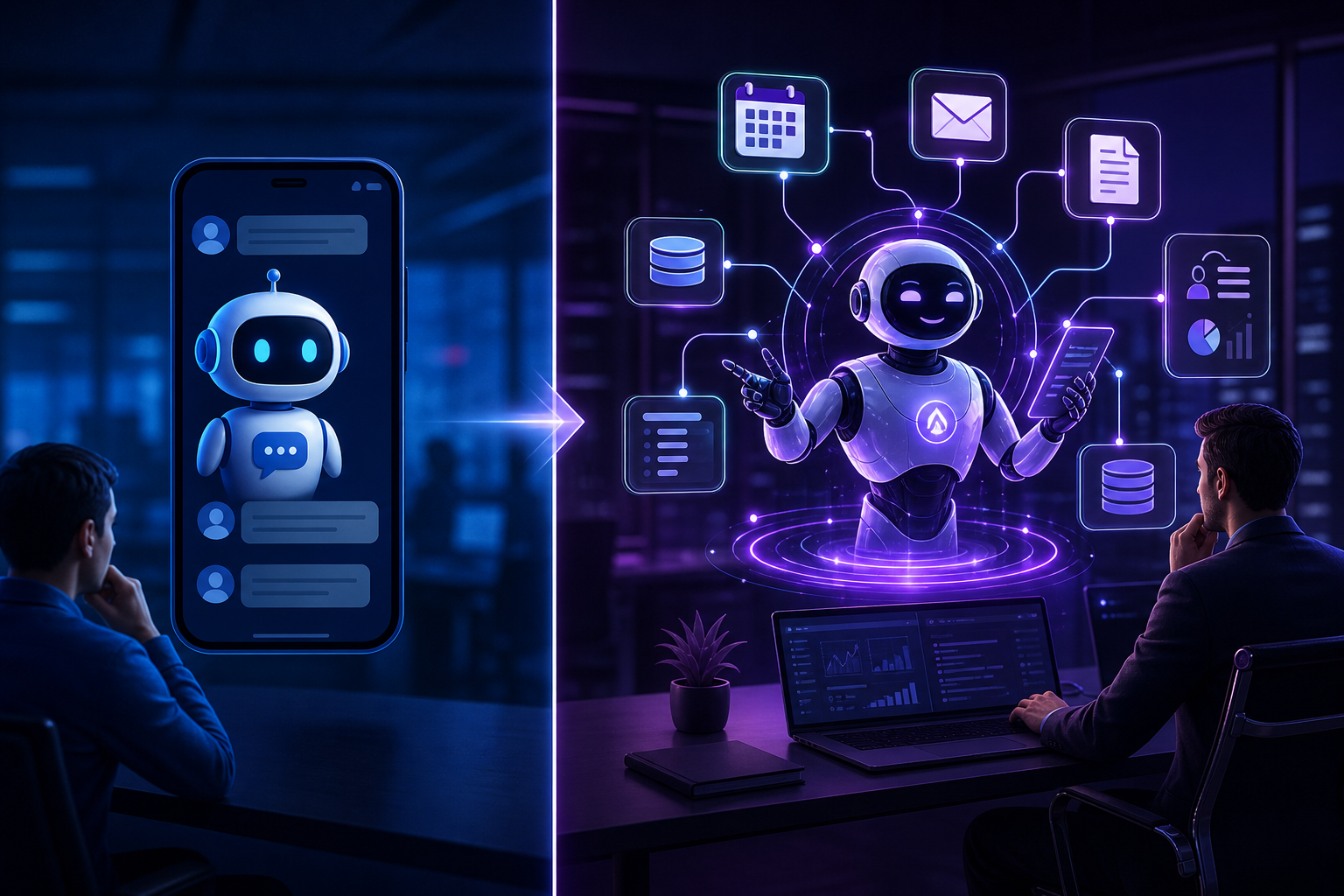
You’ve probably used a chatbot. But have you ever worked with an AI that actually gets things done?
That’s the gap most businesses don’t see coming — and it’s costing them more than they realize.
They’re Not the Same Thing
People often use “AI chatbot” and “AI agent” interchangeably. They shouldn’t.
A chatbot reacts. An agentic system acts.
That one-word difference changes everything about how AI delivers value inside a business.
What Is an AI Chatbot?
An AI chatbot is a conversation interface. It takes your message, processes it, and sends back a response. That’s its job — and it does it well.
Best used for:
- Answering FAQs and support queries
- Guiding users through a product or service
- Capturing leads on a website or app
- Simple, repetitive customer interactions
Here’s the catch: A chatbot tells you what to do. It can’t actually do it. Ask it to process a refund, update your CRM, or reschedule a client — and you’ll get a very polished set of instructions. Nothing more.
What Is an Agentic AI System?
An agentic system is a goal-driven AI that can plan, decide, and execute — without being hand-held through every step.
Feed it an objective. It breaks that goal into tasks, picks the right tools, calls the right APIs, handles errors mid-way, and delivers an outcome.
What it can do that a chatbot can’t:
- Book a meeting AND send a confirmation AND update your calendar
- Monitor your pipeline AND flag at-risk deals AND draft follow-up emails
- Process a customer complaint AND issue a partial refund AND log it in your system
Pro Tip: If your process involves more than two steps across more than one tool — you don’t need a chatbot. You need an agent.
Side-by-Side Comparison
| Feature | AI Chatbot | Agentic AI System |
|---|---|---|
| Core job | Responds to input | Executes goals |
| Memory | Session-only | Persistent & task-aware |
| Tool use | Minimal | APIs, code, databases |
| Decision-making | Single-step | Multi-step reasoning |
| Supervision needed | Every action | Goal level only |
| Ideal for | Queries, FAQs | Workflows, automation, ops |
Real-World Example
A fintech startup deployed a chatbot to handle loan application queries. Response time improved. Support volume dropped. Good result.
Then they switched to an agentic system. Now when a user submits an application, the agent pulls credit data, validates documents, flags incomplete fields, scores the application, and routes it to the right team — automatically.
Same AI budget. Ten times the output.
2026: The Year Agentic AI Goes Mainstream
This isn’t a future trend. It’s happening now.
What’s shifting in 2026:
- Multi-agent systems — specialized agents working in parallel on different parts of the same workflow
- Agent-native mobile apps — apps where the AI doesn’t just chat, it handles backend logic
- On-device agents — faster, private, no cloud round-trip needed
- Agentic APIs — platforms like OpenAI, Anthropic, and Google now offer agent-ready infrastructure
Quick Take: Gartner projects that by end of 2026, over 40% of enterprise apps will feature task-specific AI agents. The window to get ahead of this is closing fast.
Which One Should You Build?
Go with a chatbot if: You need fast, low-cost deployment for support or lead gen.
Go with agentic AI if: You want AI that drives business outcomes — not just conversations.
Best answer for most growing businesses? Both. A conversational front-end powered by an agentic backend.
Let’s Build What Actually Moves the Needle
At Innocreek Solution, we don’t build generic bots. We design custom AI and agentic systems that fit your specific business logic — from intelligent mobile app automation to full multi-step workflow agents.
If you’re ready to go beyond chatbots, let’s talk →
FAQ SECTION
Q1. What is the main difference between an AI chatbot and an agentic AI system? An AI chatbot responds to user inputs conversationally. An agentic AI system executes multi-step goals autonomously using tools, APIs, and decision-making logic — without constant human direction.
Q2. Can a chatbot become an agentic system? Not really. A chatbot can be enhanced with tool integrations, but true agentic behavior requires a different architecture — goal decomposition, memory, and autonomous task execution. They’re built differently from the ground up.
Q3. Is agentic AI suitable for small businesses and startups? Yes. Agentic systems don’t require enterprise budgets. Startups are actually the fastest adopters because agents eliminate the need for large operations teams early on.
Q4. What industries benefit most from agentic AI in 2026? Fintech, healthtech, e-commerce, real estate, and SaaS companies see the highest ROI. Any business with repetitive multi-step workflows is a strong candidate.
Q5. How long does it take to build a custom agentic AI system? A focused MVP agentic system can be built in 4–8 weeks depending on complexity and integrations. Starting with one automated workflow and expanding is the most effective approach.
