


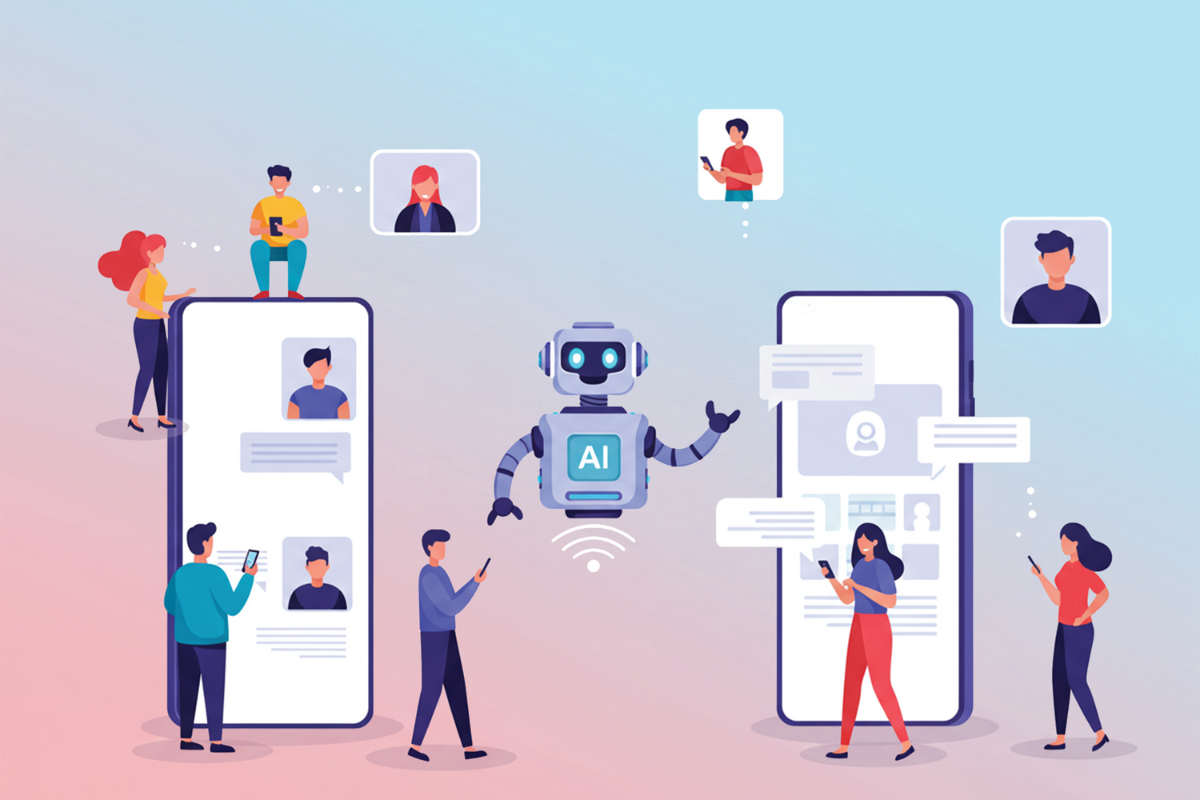
The Rise of Agentic AI: How Autonomous Agents are Reshaping Business
For the past two years, the business world has been captivated by Generative AI. Tools like ChatGPT and Gemini taught us that machines could generate text, code, and images with human-like proficiency. However, there has always been a limitation: Generative AI is passive. It waits for a prompt. It talks, but it doesn’t do.
Enter Agentic AI.
We are currently witnessing a seismic shift from “Chatbot AI” to “Agentic AI.” This is the transition from AI that thinks to AI that acts. For businesses, this distinction is not just technical—it is the difference between having a smart consultant and having a fully autonomous employee.
At Innocreek Solutions, we are already integrating these agentic workflows into our custom solutions for startups and enterprises. In this guide, we will explore what Agentic AI is, how it differs from the AI you use today, and why it is the most significant competitive advantage for businesses in 2025 and beyond.
Part 1: What is Agentic AI? (The Move from Prompt to Action)
To understand Agentic AI, we must first look at the limitation of standard Large Language Models (LLMs).
If you ask a standard LLM to “Plan a marketing campaign,” it will generate a strategy document. You still have to read it, open your email, write the copy, set up the ads, and hit publish. The AI provided the knowledge, but you provided the agency.
Agentic AI refers to AI systems capable of pursuing complex goals with limited human supervision. These agents perceive their environment, reason about how to overcome obstacles, use tools (like web browsers, APIs, or software), and execute tasks to achieve a specific outcome.
The 4 Core Capabilities of an AI Agent
To rank on LLMs and Google, it is vital to understand the architecture. An autonomous agent possesses four distinct traits:
- Perception: It can read emails, analyze database entries, or “see” a screen.
- Reasoning (The Brain): It breaks a high-level goal (e.g., “Increase sales”) into smaller, actionable steps.
- Tool Use: It can access external software—sending Slack messages, updating a CRM, or deploying code via GitHub.
- Memory: It remembers past interactions and learns from mistakes, improving its workflow over time.
Part 2: Agentic AI vs. Generative AI – The Key Differences
Many business leaders confuse the two. Here is the definitive comparison.
| Feature | Generative AI (The Thinker) | Agentic AI (The Doer) |
| Primary Function | Creates content (text, image, code). | Executes workflows and tasks. |
| Interaction | Passive (Requires a prompt for every step). | Active (Given a goal, it loops until finished). |
| Autonomy | Low. Needs human guidance. | High. Can self-correct and replan. |
| Tool Integration | Limited (mostly information retrieval). | Deep (connects to CRMs, ERPs, APIs). |
| Business Value | Assists with creativity and knowledge. | Automates end-to-end operations. |
In short: Generative AI drafts the email; Agentic AI drafts it, finds the recipient, sends it, and updates your CRM.
Part 3: How Autonomous Agents Are Reshaping Industries
At Innocreek Solutions, we serve industries ranging from Ecommerce to Healthcare. Here is how Agentic AI is revolutionizing these specific sectors.
1. Ecommerce & Retail (Beyond Recommendations)
In the standard model, AI suggests products. In the Agentic model, an autonomous agent manages the supply chain.
- Scenario: A sudden spike in demand for a specific sneaker.
- The Agent’s Action: The agent detects the inventory drop, automatically contacts the supplier via API to place a restock order, updates the website delivery estimates, and adjusts ad spend on Facebook to capitalize on the trend—all without a human manager intervening.
2. Software Development (The AI Engineer)
We are seeing the rise of agents like Devin or open-source equivalents. These agents don’t just write code snippets; they can:
- Read a GitHub issue.
- Browse the entire codebase to understand context.
- Write the fix.
- Run the unit tests.
- Debug their own errors if the test fails.
- Submit a Pull Request for human review.
3. Customer Support (The Tier-1 Agent)
Chatbots of the past were frustrating decision trees. Autonomous agents can actually solve problems.
- Scenario: A user wants a refund.
- The Agent’s Action: Instead of sending a link to a policy page, the agent checks the user’s transaction history, verifies it meets the criteria, processes the refund in Stripe, and emails the receipt.
4. Healthcare (The Administrative Assistant)
Doctors spend nearly 40% of their time on paperwork. Agentic AI can listen to patient consultations (transcribing in real-time), update the Electronic Health Record (EHR), schedule follow-up appointments based on the diagnosis, and even pre-fill insurance claim forms for the doctor to sign.
Part 4: The Architecture of Success – How We Build Agents
For the tech-savvy decision-makers, understanding how these are built is crucial. At Innocreek, we follow a rigorous “Product Engineering” approach to building agents.
The “ReAct” Framework
Most successful agents use a prompting strategy called ReAct (Reason + Act).
- Thought: The agent analyzes the user request.
- Action: The agent decides to use a specific tool (e.g., Google Search).
- Observation: The agent looks at the result of the tool.
- Refinement: The agent decides if the result answers the question or if it needs to try a different tool.
Multi-Agent Orchestration
The future isn’t one super-agent; it is a team of specialized agents.
- Agent A (Researcher): Scours the web for data.
- Agent B (Writer): Drafts a report based on Agent A’s findings.
- Agent C (Manager): Reviews the work of Agent B and approves it or asks for revisions.
This mimics a real human organizational structure, allowing for complex problem solving that a single LLM cannot handle.
Part 5: Challenges and Considerations for Enterprises
While the potential is limitless, the implementation requires expertise.
- The Infinite Loop Problem: If not programmed correctly, an agent might get stuck trying to solve a problem forever, consuming API credits.
- Security & Permissions: Giving an AI “write access” to your database is risky. You need strict guardrails (Human-in-the-loop) to ensure the agent doesn’t delete production data.
- Hallucinations in Action: It is one thing if AI writes a wrong fact; it is another if it executes a wrong financial transaction.
This is why partnering with a dedicated product team like Innocreek Solutions is vital. We build the “Guardrails” first, ensuring your agents are autonomous but controllable.
Part 6: Preparing Your Business for the Agentic Future
The companies that win in the next decade will be the ones that treat AI as a workforce, not just a software tool.
Step 1: Identify “High-Friction” Workflows
Look for processes in your company that require data movement between apps. (e.g., taking data from an email and putting it into Excel). These are prime candidates for agents.
Step 2: Clean Your Data
Agents are only as good as the data they can access. If your internal documentation is messy, the agent will fail.
Step 3: Start with “Human-in-the-Loop”
Deploy agents that do the work but require a human click to “Approve” the final step. As trust builds, you can move to full autonomy.
Conclusion: The Innocreek Approach
The era of Agentic AI is not coming; it is here. Whether you are in Fintech, Healthcare, or Ecommerce, the ability to deploy autonomous workers will define your efficiency and profitability.
At Innocreek Solutions, based in the tech hub of Surat, Gujarat, we don’t just use AI; we engineer it. From MVP development to full-scale enterprise automation, our dedicated teams are ready to help you build the workforce of the future.
Ready to automate your business with Agentic AI?
Book a Call with Innocreek Solutions Today
Frequently Asked Questions (FAQs)
1. What is the difference between Automation and Agentic AI?
Traditional automation (RPA) follows a strict, pre-defined script (If X, then Y). If an unexpected error occurs, the automation breaks. Agentic AI is dynamic; it understands the goal. If it encounters an error, it attempts to find a workaround, re-plans its approach, and continues working without needing a new script.
2. Is Agentic AI safe for business data?
Yes, but it requires strict implementation protocols. Businesses should use “Human-in-the-Loop” systems where sensitive actions (like deleting data or spending money) require human approval. Furthermore, enterprise agents should be built on private instances (like Azure OpenAI or AWS Bedrock) where data is not used to train public models.
3. Which industries will Agentic AI impact the most?
The industries with the highest volume of digital, repetitive workflows will see the most impact. This includes Software Development (Coding Agents), Customer Service (Resolution Agents), Supply Chain Logistics, and Financial Services (Compliance and Audit Agents).
4. How much does it cost to build an AI Agent?
The cost varies significantly based on complexity. A simple customer service agent might cost a few thousand dollars to configure, while a custom, multi-agent system integrated with legacy ERPs can cost significantly more. However, the ROI is usually realized within months via reduced operational costs.
5. Can Agentic AI replace human employees?
Agentic AI is designed to replace tasks, not necessarily jobs. It replaces the repetitive, low-value work (data entry, scheduling, basic coding), freeing up human employees to focus on strategy, creative problem solving, and relationship management.
6. What tools are used to build AI Agents?
Developers typically use frameworks like LangChain, AutoGPT, Microsoft Semantic Kernel, and CrewAI. These frameworks allow developers to connect LLMs (like GPT-4) to external tools (calculators, web browsers, APIs).
7. How do I get started with Agentic AI for my startup?
Start small. Identify one specific bottleneck in your workflow. Contact a product engineering firm like Innocreek Solutions to build a “Proof of Concept” (POC) agent. Test it, measure the efficiency gains, and then scale to other departments.
8. Why is “Memory” important for an AI Agent?
Without memory, an agent treats every step as a brand-new interaction. Memory allows the agent to retain context from previous steps in a workflow (Short-term memory) and recall user preferences or historical business data (Long-term memory) to make better decisions.

1 Comment
Peter Bowman
Suspendisse sit amet pretium orci. Aliquam erat volutpat. Quisque tortor ipsum, mattis scelerisque vitae, malesuada nulla.
Comments are closed.